
 (03) 9022 6475
Hire and Hope : Why your next salesperson needs a road, not a wish

I was speaking with a founder recently who hired a salesperson he really liked. Great culture fit. Smart. Keen. There was hope.
Hope that the growth goals would start moving into reality.
Ten weeks in, no sales.
He wasn't angry. He was worried. Worried about the money, worried about whether he'd got it wrong, and quietly worried about something bigger… that he didn't actually know how to help.
The same week, another founder told me a story I hear all the time. He's hired salespeople before. They didn't work out. And every time, the selling slid back onto his desk.
Two different businesses. Two different stories. But between them, the same pattern I see.
One pattern.
And right now, the market data says a lot of business owners are standing exactly where they are.
The numbers : Fewer ads, more applicants
I've started tracking every month how many businesses advertise for salespeople in Sydney, Melbourne and Brisbane. I'm calling it the Sales Hiring Pulse.
Here's what the first read shows.
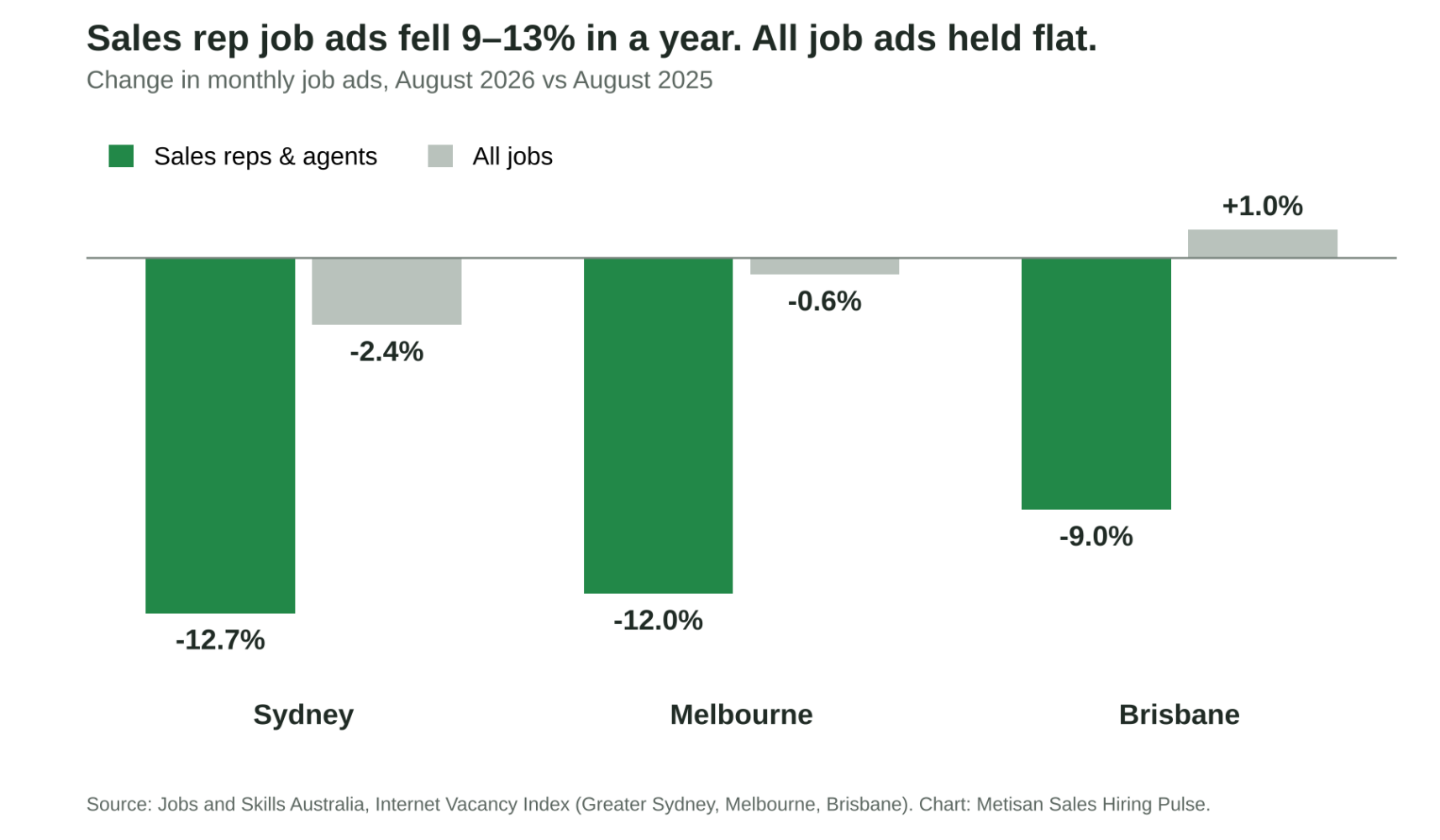
Over the last year, job ads for sales reps fell 12.7% in Sydney, 12% in Melbourne and 9% in Brisbane. Over the same year, the job market as a whole barely moved: down 2.4% in Sydney, down 0.6% in Melbourne and up 1% in Brisbane.
Over two years, sales rep ads are down about one in five in all three cities. Sales hiring isn't following the market down. It's falling four to five times faster.
And here's the other side of it. SEEK reports that applications per job ad hit a record high this year. So the businesses that do advertise for a salesperson get flooded with applicants.
On SEEK right now there are around 4,000 sales roles advertised across the three cities. About a quarter are new business development roles: the hunters. One in five is account management. Commission-only? Under 1%. It's a fringe model, not the way good B2B firms hire.
In plain terms:
- Fewer businesses are hiring salespeople.
- The ones who do have more choice than ever.
- And it's still not working for a lot of them.
Naming the pattern : Hire and Hope
Looking at what both founders actually did.
They found someone good. They gave them a laptop, a CRM login and a target. Then they went back to running the business… and hoped. This is absolutely not because they're careless. The primary reason is that sales isn’t something that business owners (normally) understand and there isn’t a plan that shows exactly how to measure the first 90 days. And yes of course they're busy, and nobody ever showed them what comes after the offer letter.
Hire and Hope (noun): the practice of recruiting a salesperson into a business that has no road for them to walk, then waiting to see whether talent alone will produce revenue.
Hire and Hope is everywhere. Here is what it looks like:
- A target, but clear picture of which clients to talk to, or the roadmap to winning.
- Activity expected, but never defined or broken into starting, walking, running.
- A weekly catch-up that's really a "how's it going?" not how are we going to this weeks plan.
And when it doesn't work, the founder concludes the hire was wrong. Then they hire again. Same road, same result.
Here's the truth bomb: in today's market, finding a salesperson has never been easier. Making a salesperson hire successful hasn't changed at all.
Change the road : Change the result
So if you're the founder whose last salesperson didn't work out, I want you to hear this: you are not alone, and it probably wasn't a talent problem. It was a road problem.
A new salesperson is Dorothy, freshly dropped into Technicolor. New clients, new language, new boss. Your business looks obvious to you, and overwhelming to them. Without a Yellow Brick Road, they wander. Or they head straight for the lions and tigers and bears, oh my!
The businesses that hire well do three things differently.
- They decide before they advertise. Who are our best clients? How do they actually buy? For the person who guides those sales, what does a good week look like, in activity, not just revenue? The job ad tells that story, so the right person recognises themselves in it.
- They define success for the first 90 days. A 30/60/90-day plan covering culture, activity and outcomes. Everyone knows what "on track" looks like before day one.
- They install a rhythm. A weekly 1:1 that coaches, as well as checks. A simple scorecard. A monthly review where the owner and the salesperson both adjust. The firm is learning, the sales person is learning. Change is inevitable in that setting.
When that road is in place, you know whether a hire is working within 30 to 45 days. Not six months. Not after the money's gone. So the hope is extended as you see the road travelled, even though it is a new road, an untravelled road for you, and for your new sales person.
That's not theory for me. With this approach, 87% of the salespeople I help businesses hire succeed. When the sales engine isn’t working, it is usually clear within 45 days, because it's clear from the actual numbers, not a gut feel, and it is obvious to everyone.
And the founder? They finally get to step out of the middle.
Three things to do this week
ACTION 1: Write down what a good week looks like.
Not the revenue target. The activity: how many conversations, with whom, and what happens next. If you can't write it, your salesperson can't do it.
ACTION 2: Turn your next catch-up into a coaching session.
Swap "how's it going?" for three questions. What did you learn from a client this week? Where did a conversation stall? What do you need from me? Then listen 80% of the time.
ACTION 3: Set your 45-day checkpoint.
Put a date in the diary, 45 days from now (or 45 days from your salesperson's start). Decide today what "on track" will look like on that day, so you're judging the road, not your gut.
And if you're about to hire? Do all three before the ad goes live.
Already hired? When the hope is draining
Maybe you're reading this ten weeks in. You liked them at interview. You still like them. But every Friday you look at the numbers and feel a little more of the hope drain out. First, breathe. That draining feeling isn't failure. It's data. It's telling you the road is missing, and that's fixable.
The two most common responses are both expensive. Some founders wait it out and hope harder. Others decide it was the wrong hire and start again. Before you do either, do this.
- Check the road before you judge the person. Ask yourself honestly: did they ever get a clear picture of our best clients? Did we define what a good week looks like in activity? Is there a weekly rhythm that coaches, or a catch-up that checks? If the answer to any of these is no, you don't yet know whether you've hired the wrong person. You only know they've had no road.
- Call a restart, not a warning. Sit down together and say it plainly: "I don't think I've set you up well. Let's fix that." Then build the 30-day plan you both should have had on day one. Culture, activity, outcomes. Most good salespeople feel relief, not threat, when they hear this. They've been feeling the drain too.
- Measure the leading signs, not the sales (for the start). Sales arrive last. Before them come conversations, meetings booked, proposals sent, pipeline growing. If those are moving, the road is working and the sales will follow. If they're not, you'll see exactly where it's stuck.
- Coach every week, both ways. The weekly 1:1 has three jobs. Help the owner understand the salesperson. Help the salesperson understand the owner. And adjust the plan. When a hire stalls, look at the first two before you rewrite the plan.
- Set the 45-day decision, and keep it kind. Put a date in the diary 45 days after the restart. If the activity is there, keep refining; the results are coming. If the road is built and the activity still isn't there, you have your answer. Make the call, and part as friends. That's kinder to both of you than another six months of hoping. Either way, you'll be deciding on evidence, not on a sinking feeling at 4pm on a Friday.
Hire on purpose
This has been the job all along. Not to find a hero who'll fix sales for us, but to build a road good people can walk. Fewer businesses are hiring salespeople right now. The ones who get it right, while everyone else is hiring and hoping, will have the clearest run at the next two years.
So here's my invitation.
If you have a salesperson who isn't firing yet, or you're thinking about hiring one, let's talk. Book a 15-minute Sales Hire Check with me. You tell me where it's snagging. I'll tell you honestly what I'd fix first, and whether you need me to do it.
Book here: calendly.com/f-pratt/15min or call me on 0417 331 040.
No wizard, no curtain. Just the road, and whether we're ready to walk it, together.
What's one thing your last salesperson needed that they never got? I'd love to hear.
Frances Pratt is the founder of Metisan and author of 'More Sales, Less Marketing.' She helps expert-led firms and purpose-driven leaders turn deep knowledge into deep client relationships. Because the clearest person in the room is the one who walks out with the deal.
Sources & further reading:
Jobs and Skills Australia, Internet Vacancy Index (Greater Sydney, Melbourne and Brisbane, August 2026)
SEEK sales job listings, Sydney, Melbourne and Brisbane, 16 October 2026
Dynamic Business on SEEK's June 2026 employment data