
 (03) 9022 6475
The Emerald Manifesto: The ultimate guide to authentic selling

This article is my manifesto on authentic selling.
No ick, or sleaze.
Just grace and ease.
That's what Authentic Selling is.
This guide is authentic selling for non-salespeople.
Table of Contents
- The Great Sales Mirage: Why You Hate Selling (And Why You’re Wrong)
- The Trust Equation: The Mathematical Secret to Human Connection
- The Sisterhood of Success: Why Marketing Can’t Save a Bad Sales Process
- The Yellow Brick Road Strategy: Mapping the Client’s Technicolor Journey
- The Rule of Thirds: Mastering the Numbers Without Losing Your Soul
- Meetings That Rock: The "You, Me, and Next Step" Framework
- Crunchy Conversations: Finding the "Lean-In Factor"
- The Fortune is in the Follow-Up: Graceful Persistence
- Shut the Back Door: Why Referrals are Your Only True Currency
- Conclusion: You’ve Always Had the Power
Chapter 1. The Great Sales Mirage: Why You Hate Selling
Authentic Selling (noun): A values-aligned sales approach focused on helping people make better decisions, rather than manipulating them into purchases. Authentic Selling replaces pressure and persuasion with service, trust, and human connection.
If I had a dollar for every time someone told me they hated selling, I’d be a millionaire!
For many purpose-led business owners and technical experts, selling feels uncomfortable, ego-driven, and entirely misaligned with their core values. When you think of sales, your mind likely conjures up an image of the dodgiest, slimiest salesperson in the world (a master of "crocodile selling" - who manipulates people into buying things they neither need nor want).
You fear being perceived as pushy or "salesy," you hide your humanity behind awkward tactics or avoid selling altogether. You suffer from the illusion that good people shouldn't have to sell, and that if you do meaningful work, it should simply speak for itself.
Let’s be real: most business owners would rather clean a grout line with a toothbrush than "sell." We’ve been conditioned to view sales as a "crocodile" sport—predatory, slimy, and purely interested in the wallet. This is what I call Bad Selling, and it’s why you cringe.
This is the Great Sales Mirage. You hate selling because you are doing it the wrong way
But here is the "Technicolor" truth: Authentic Selling is just helping people buy.
In the modern era, the "Hard Sell" is officially dead. According to Harvard Business Review, the shift toward "Subscription-based" and "Relationship-based" models means that a pushy sale is actually a financial liability.
- Source: HBR: The New Science of Customer Emotions (PDF/Article) – Research shows that emotionally connected customers are 52% more valuable than those who are just "highly satisfied."
The truth is, authentic selling isn’t something you do to others; it is something you do with others. Selling is not about manipulation or reciting the "Shamsters Book of Sales Techniques". Authentic selling is simply helping people buy. It is about helping someone who has a problem fix that problem or fulfill a need. When you reframe sales as an act of service rather than servitude, your entire posture changes. You stop focusing on your own quota and start focusing on the client's journey.
To break free from this mirage, you must embrace the Two Golden Rules of Authentic Selling: Be Yourself and Get Over Yourself. You do not need to adopt an artificial persona to succeed; whether you are an introvert, an analyst, or a storyteller, you must be authentic.
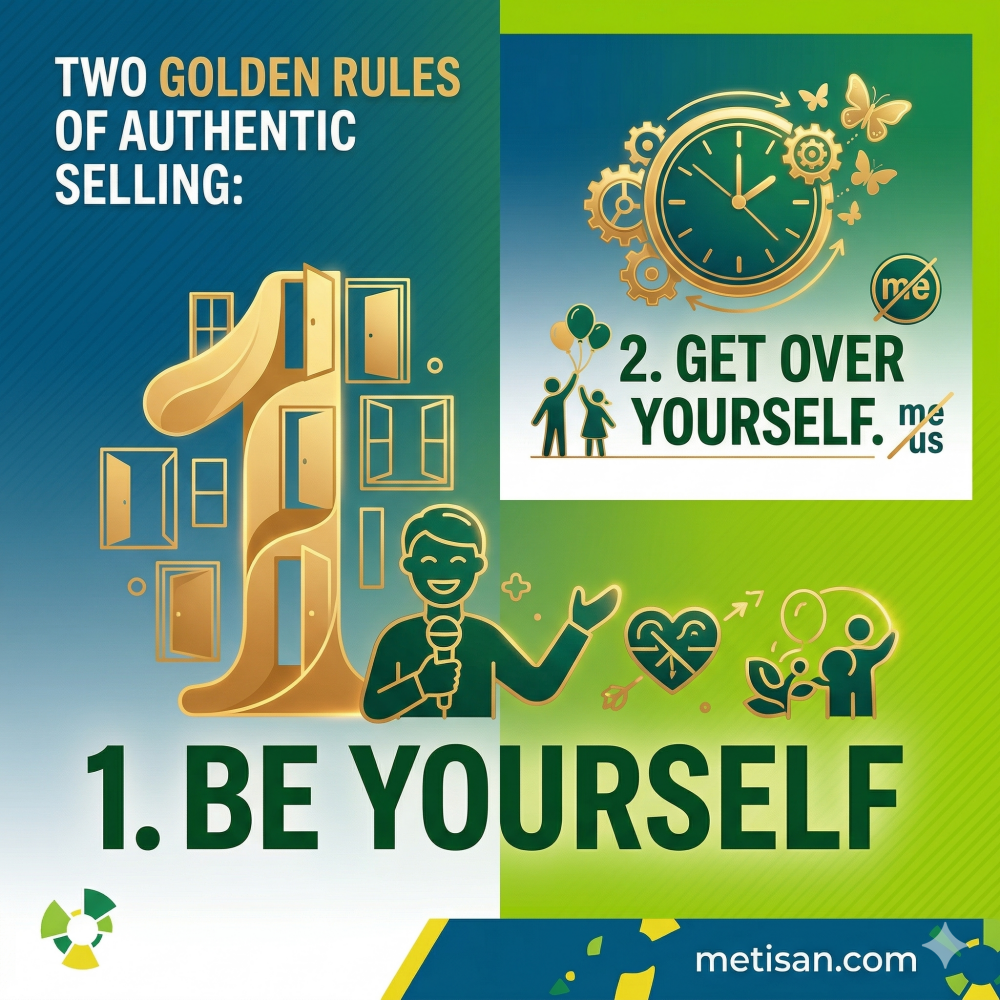
However, being yourself does not excuse inaction. You must get over your fear of rejection, step into your authority, and give yourself permission to be great at sales.
Write down all the slimy, "yucky" things you hate about sales and throw them away. Then, visualize your inner "shining sales goddess" (or champion) and step confidently into your role as a guide. When your intention shifts to genuinely helping people make better decisions, selling stops feeling like a manipulative chore and starts feeling like a deeply human connection.
If you have a solution to a problem that’s keeping someone up at night, staying silent isn't being polite—it’s being unhelpful. You aren't a predator; you’re Glinda, showing them the path they already have the power to walk.
Chapter 2. The Trust Equation: The Mathematical Formula for human Connection and relationship
The Trust Equation (noun): A formula for professional trust, defined as: Trust = (Credibility + Reliability + Intimacy) ÷ Self-Orientation. Developed by Maister, Green, and Galford, and taught at Harvard and INSEAD.
Trust isn't just a "vibe"; it’s a quantifiable metric. Based on the work of Maister, Green, and Galford, and central to the Metisan philosophy, we use the Trust Equation. This formula is taught at Harvard and INSEAD as the gold standard for professional services.
The things that build trust:
- Credibility: Your qualifications (The "Rational" part).
- Reliability: Doing what you say you’ll do.
- Intimacy: The safety a client feels sharing sensitive "pain" with you.
The thing that destroys trust.
- Self-Orientation: This is the denominator. If your focus is on yourself (your commission, your targets, your ego), trust plummets.
In the dance of sales, trust is everything. If a prospective client does not trust you, your product, or your company, they simply will not buy from you, regardless of how brilliant your solution might be.
Fortunately, trust is not an elusive, magical aura; it is a mathematical formula that you can actively build into your sales process. Based on David H. Maister's work, the Trust Equation is: Trust = (Credibility + Reliability + Intimacy) / Self-Orientation.
Credibility is the rational and emotional belief that you are an expert who tells the complete truth. While technical experts naturally possess rational credibility (qualifications, case studies, and letters after their names), emotional credibility is harder to earn.
Credibility requires you to address the client's hidden fears directly, tell the truth even when it's uncomfortable, and admit when you do not know the answer.
Reliability is straightforward but often fumbled: say what you do, and do what you say. Reliability is built slowly over time through consistent, positive interactions.
Reliability means sending the follow-up email you promised, honoring your meeting times, and uncovering the client’s unspoken expectations; such as whether they prefer a morning or afternoon phone call.
Intimacy is the most critical element on the top of the equation. Intimacy is achieved when a client feels safe enough to share sensitive issues, deep fears, or emotional connections to their business problems.
Building intimacy requires you to take a risk and show your emotional hand first. By asking probing, "feeling" questions and giving the client a safe space to answer or avoid them, you invite deep, authentic partnership.
However, all of these positive elements can be instantly destroyed by the denominator: Self-Orientation (or Conflict of Interest). If a client senses that you are more interested in your own quota, ego, or brilliant pitch than in solving their problem, trust evaporates.
To master the Trust Equation, you must lower your self-orientation by listening intently, acting transparently, and focusing entirely on the best interests of the client.
Recent studies from the University of Melbourne on "Trust in Australian Business" highlight that "Self-Orientation" is the #1 reason for consumer cynicism in the B2B sector.
- Source: The Australian Trust Index (Research Summary) – Explore the data on why low self-interest is the key driver of corporate trust.
Chapter 3. The Sisterhood of Success: Why Marketing Can’t Save You
Journey Friction (noun): The disconnect that occurs when a marketing promise is not matched by the sales experience, causing a prospective client to disengage. Journey Friction is eliminated when marketing, sales, and customer success are fully aligned.
Marketing and Selling are sisters, not twins.
Many business owners operate under the delusion that if they just get their marketing right, the sales will naturally follow. They pour money into lead generation, websites, and advertising, assuming that marketing can mask a broken or non-existent sales process.
The sisters of marketing and sales must work in tandem; marketing cannot save a bad sales process because marketing brings people to the door, but sales is the human interaction that invites them inside and helps them make a decision.
A successful business model relies on the seamless integration of Brand Experience (BX), Customer Experience (CX), and User Experience (UX). Marketing generates awareness, but consumers are not just deciding if they want to buy your product; they are deciding if they buy into your brand experience, your identity, and your community.
When a marketing campaign promises a deeply caring, expert-led solution, but the subsequent sales conversation is disjointed, self-centered, or pushy, the client experiences immediate dissonance.
This is what we call "Journey Friction"; when the buying and onboarding process feels harder than it should.
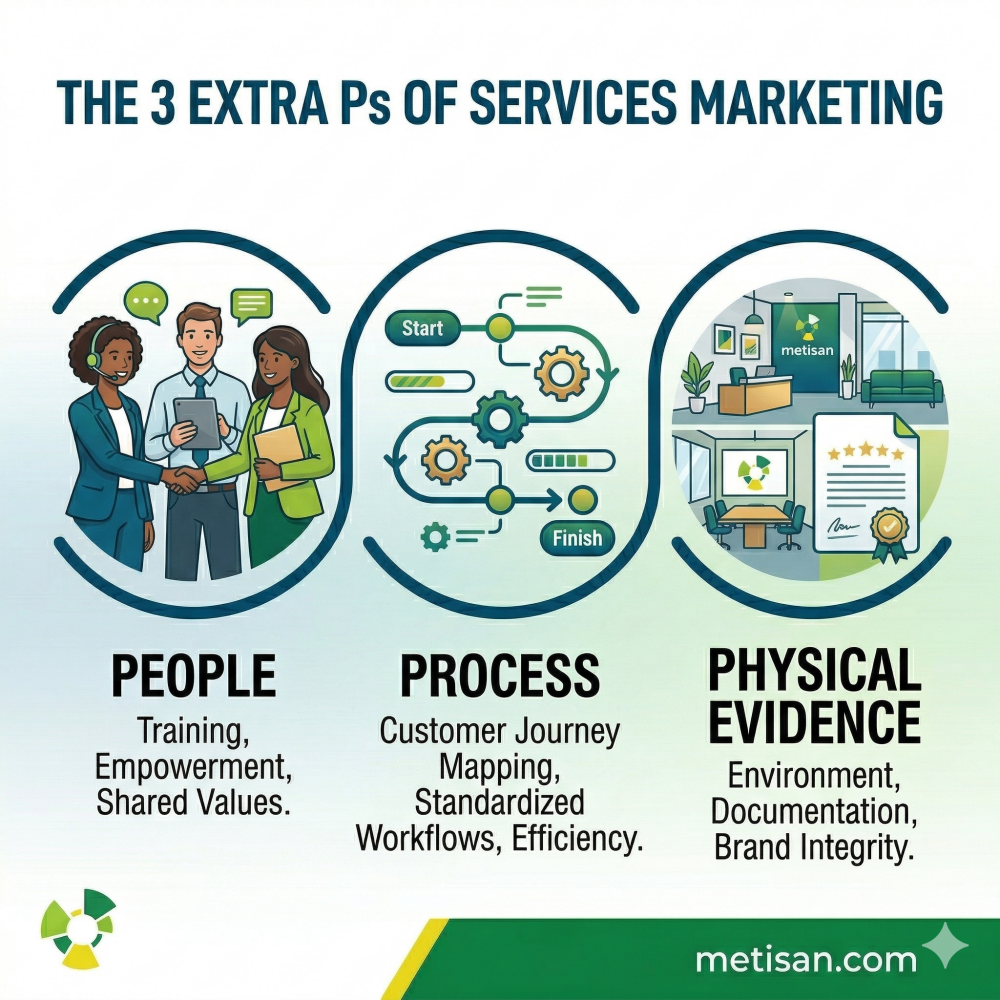
For service-based businesses, you must extend beyond the traditional 4 P's of marketing and embrace the 3 extra P's of Services Marketing: People, Process, and Physical Evidence.
Your People are how the client experiences your company; they must be trained to consistently deliver on your brand promise with confidence and empathy.
Your Process is the transparent system you use to onboard and manage clients, showing them exactly how you operate so they feel safe.
Your Physical Evidence (reports, case studies, brand environments) provides tangible proof of your intangible value.
If your messaging is unclear, you suffer from "Value Friction," where 66% of founders admit their value simply isn't landing.
You cannot fix this by shouting louder with more marketing. You must align marketing, sales, and customer success around shared goals and a consistent, human-centric revenue culture.
When the "sisterhood" of marketing and sales is truly aligned, you stop relying on ad-hoc transactions and start building a robust, relationship-led growth engine.
Chapter 4. The Yellow Brick Road Strategy: Mapping the Client's Journey
The Yellow Brick Road Strategy (noun): A client-centred sales framework that maps each stage of the buying journey as a transparent, step-by-step roadmap. Modelled on the Wizard of Oz, it positions the salesperson as guide (Glinda), not hero.
Selling is profoundly misunderstood. Part art form, part science. It is not a transaction, but a sacred journey. To sell authentically, you must shift your perspective and view the sales process through the eyes of your client.
Think of your client as Dorothy from The Wizard of Oz. When they first realize they need help, they have experienced some sort of turmoil or "storm". Suddenly, they are thrust out of their comfortable, predictable black-and-white reality and into the daunting, unknown world of Technicolor.
In this foreign place, your client is afraid and looking for guidance. They do not want you to be the hero who swoops in and solves everything for them; they want you to be Glinda the Good Witch. Glinda knows that Dorothy has the power to get home, but she doesn't push her or carry her. Instead, Glinda addresses Dorothy's fears, provides a credible pathway (the Yellow Brick Road) and allows her to take her own journey of discovery
Your clients; just like Dorothy land in Oz: overwhelmed, frightened, and unsure of the first step. A Sales Roadmap is your most powerful tool to lead them through the woods.
Your Sales Process is your Yellow Brick Road. It is a transparent, step-by-step "Client Roadmap" that shows prospective clients exactly how they will engage with your company, from pre-engagement to delivery and post-delivery review.
By presenting this roadmap early, you start by showing them you understand their fear of the unknown and prove that you have a safe, tested system for solving their problems.
You must also align your roadmap with the client's internal buying cycle. This cycle moves from Determining Needs (what are they looking for?), to Evaluating Alternatives (who is involved in the decision?), to Evaluating Risks (what if this all goes pear-shaped?), to Selection/Negotiation, and finally Implementation.
At each stage, the client is asking different questions and feeling different emotions. Your job is not to rush them to the Emerald City, but to walk alongside them, providing the exact tools, stories, and reassurance they need to confidently take the next step on their journey.
The Three Phases of the Client Journey are:
- Pre-engagement: Building trust and finding the "fit."
- Delivery: Walking the talk.
- Post-delivery: Ensuring they never want to leave.
Source: INSEAD: Customer Journey Mapping Research – Research into why transparency in the "journey" leads to higher retention.
Chapter 5. The Rule of Thirds: Mastering the Numbers
The Rule of Thirds (noun): A sales pipeline principle stating that of any qualified prospects, one-third will say yes, one-third will delay, and one-third will say no. Coined by Frances Pratt of Metisan, it requires a pipeline at least three times the size of your target new clients.
According to ASBFEO (Australian Small Business and Family Enterprise Ombudsman), nearly 60% of startups fail within five years. Why? Because they don't treat sales as a numbers game.
- Source: ASBFEO Small Business Data Portal (Live Stats) – The latest data on Australian small business survival and growth trends.
While sales is deeply rooted in human connection, it is fundamentally a numbers game. However, mastering the numbers does not mean losing your soul or treating clients like mere data points.
It does mean creating a structural reality where your effort directly translates into predictable, sustainable revenue. If you set a massive revenue goal without defining the daily, weekly, and monthly activity inputs required to reach it, you create a "Vague Road Map". This fog bank allows underperformance to hide behind "busy work," where salespeople spend hours prepping but only 28% of their week actually selling.
To master the numbers, you must break them down into actionable steps. For each type of sale, calculate exactly how many networking contacts lead to phone calls, how many calls lead to discovery meetings, how many meetings lead to proposals, and how many proposals convert into paying clients. Once you know your conversion ratios, selling simply becomes a matter of discipline and "eating your greens"—setting aside protected time in your diary every week to execute these activities.
This requires establishing strong Sales Rhythms. You need Daily Habits (15-30 minutes of setting intentions and sending thoughtful reconnect messages), Weekly Rhythms (30-90 minutes of reviewing your pipeline, practicing your pitch, and putting on your "client goggles"), and Monthly Habits (resetting your mindset and reviewing your offer alignment).
Furthermore, you must embrace the "Measure – Do – Measure" philosophy. As Peter Drucker famously said, "Don't expect what you don't inspect". By tracking your success rates with both warm leads (existing clients) and cold leads (new clients), you gain invaluable data on where potential clients are falling out of your funnel. This data allows you to diagnose structural weaknesses in your business, adapt your approach, and provide courageous success coaching to your team. When you master the numbers through clear inputs and consistent rhythms, sales stops feeling like a chaotic hustle and becomes a calm, confident, and deliberate engine for growth.
And if you want to grow - then you need to have enough fuel in the pipeline to fund that growth. This is where the sales numbers are your friend and knowing your sales numbers is essential to being able to deliver calmly and with grace. Too often I see frazzled business owners or sales people - not because they aren't good at what they do - but simply because they aren't playing the sales numbers game to their advantage.
This is where this sales rule comes in.
Fran's "Rule of Thirds":
- One-third will say yes.
- One-third will delay.
- One-third will say no.
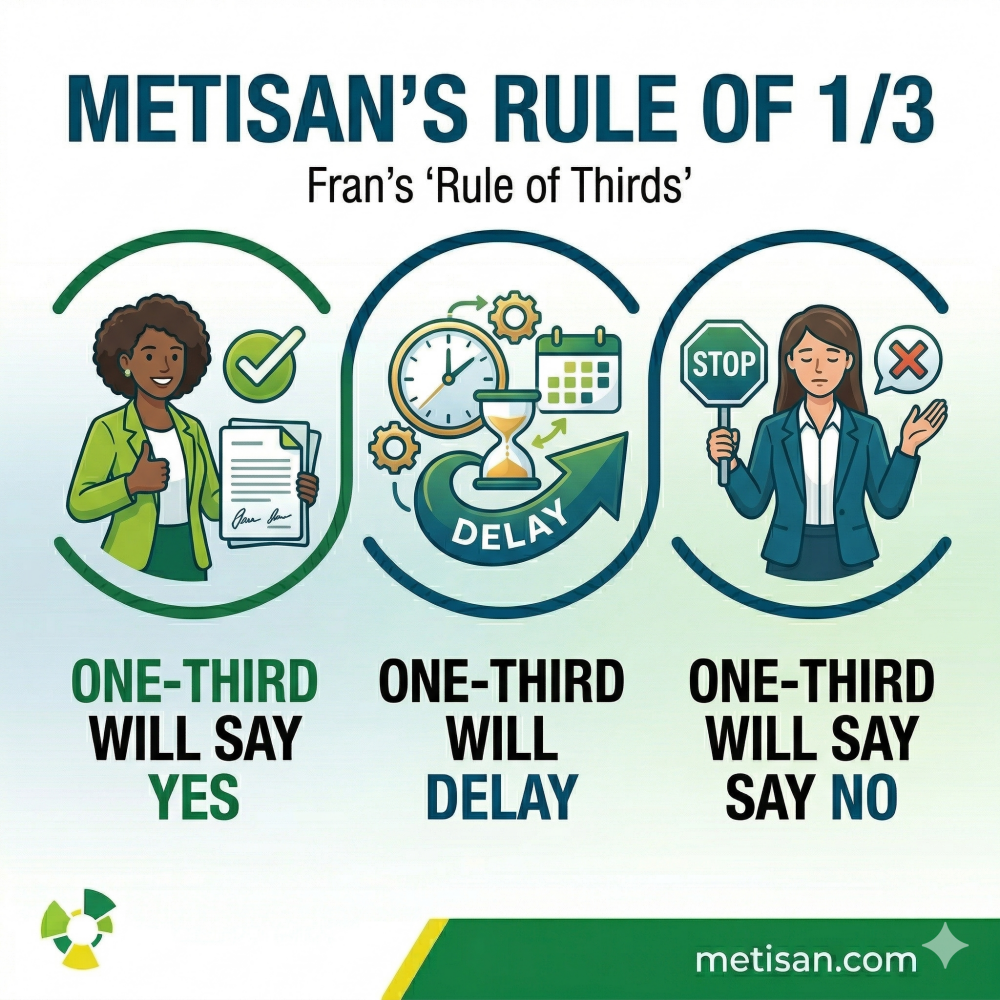
If you need three new clients this month, you need at least nine high-quality potentials in your pipeline. Desperation is the "Flying Monkey" of sales—it ruins everything.
So having the right kind of and numbers of opportunities in your sales pipeline allows you to walk with ease and grace with each client, without watching over your shoulder for the flying monkeys. Or cringing at each hesitation or no.
Chapter 6. Meetings That Rock: The 80/10/10 Rule
The You, Me & Next Step Framework (noun): A sales meeting structure developed by Frances Pratt, allocating 80% of meeting time to understanding the client, 10% to contextualising your solution, and 10% to agreeing a clear next action.
Stop winging your sales meetings. Authentic selling requires a structure that honors the client's time.
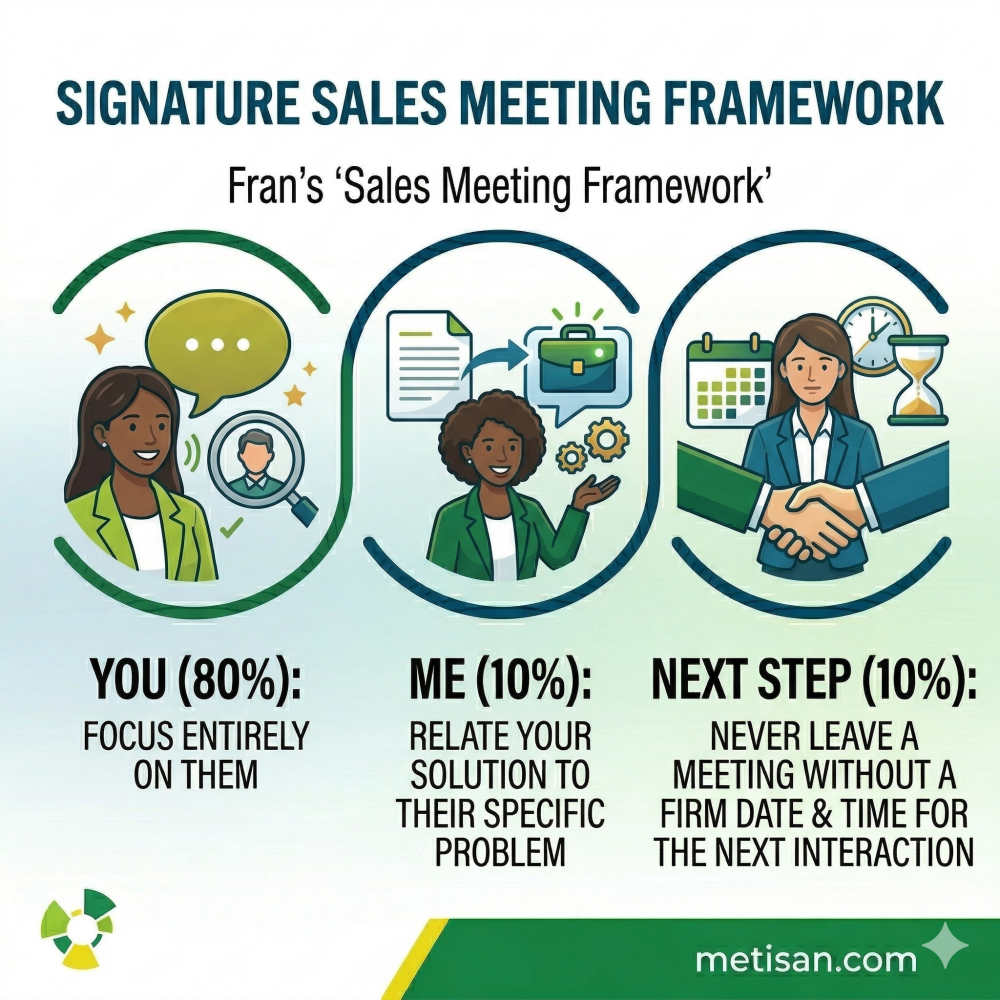
- YOU (80%): Focus entirely on them. Use the 7-38-55 rule (Mehrabian’s Principle).
- Source: The 7-38-55 Rule of Communication (Summary PDF) – Understand why 55% of your message is body language.
- ME (10%): Relate your solution to their specific problem.
- NEXT STEP (10%): Never leave a meeting without a firm date and time for the next interaction.
A successful sales meeting is never a monologue; it is a carefully choreographed dance. When business owners enter a discovery call feeling nervous or needy, they often fall into the trap of talking endlessly about themselves, their achievements, and their company history.
This self-centered approach alienates the buyer immediately. To run meetings that genuinely rock, you must ditch the pitch and adopt the simple, elegant "You, Me, & The Next Step" framework that was developed by Frances Pratt.
Sales Framework Part One: YOU (80% of the meeting).
The vast majority of your initial conversation must be entirely about the client. You must act like an investigative journalist, using open-ended questions to uncover their logical needs, their emotional fears, and their hidden business drivers.
Start with what you already know from your research, but allow them to guide the narrative. Your goal is to listen deeply with your ears, eyes, body, and brain to understand the exact nature of their "storm" before you ever offer a solution.
When you spend 80% of the time exploring their world, you earn their respect and trust. You earn the right to go onto the second key step in the successful sales meeting created by Frances Pratt.
Sales Framework Part Two: ME (10% of the meeting).
Only once you fully understand the client’s problem do you earn the right to talk about yourself. This is where you summarize what you have heard to prove you were listening, and then contextualize your expertise.
You do not recite a laundry list of features or things that you are great at. Instead, you share highly relevant Sales Stories. Ideas and concepts that are relevant to what you have just heard from your new potential client.
By explaining how you helped a similar client navigate a similar problem, you provide credible proof of your value without ever sounding boastful or pushy.
By continuing to focus on and around them and their problem, you give them the best possible reason to listen well and to consider working with you.
Sales Framework Part Three:
THE NEXT STEP (10% of the meeting).
Authentic selling and this Sales Framework requires you to confidently lead the dance. Do not leave the client hanging in a state of ambiguity.
At the end of the meeting, you must be direct about the next logical actions. Whether it is scheduling a follow-up call, sending a proposal, or signing a contract, you must clearly define who is doing what and by when.
If you don't ask for the next step, they cannot say yes.
Getting into the habit of asking is another element of Authentic Selling. In my community hub at Accelerate Sales has spent one whole month focusing on ASKING.
So if getting better at sales is something that you would love to master - then Accelerate Sales and Metisan are key to helping you with this.
Chapter 7. Crunchy Conversations: Finding Your Lean-In Factor
Getting Crunchy (verb): The practice of replacing vague value statements with specific, quantifiable outcomes — such as revenue increases, cost reductions, or risk controls. A term coined by Frances Pratt of Metisan. A crunchy value proposition uses Promise, Proof, and Picture to make value tangible to the buyer.
Vague talk is the death of sales. You need to get "Crunchy".
Imprecision leads to paralysis. If your value proposition is vague or full of industry jargon, it becomes invisible to your buyer.
To capture attention and drive decisions, your sales conversations must get "Crunchy".
Getting crunchy is another term coined by Frances Pratt from Metisan and Accelerate Sales. This means moving beyond fluffy blanket statements and speaking in specific, quantifiable, and deeply resonant terms to your buyer.
Getting "crunchy" means moving away from vague, fluffy blanket statements and getting highly specific and quantifiable about the value you provide. To do this, you must clearly articulate the "hard benefits" or Return on Investment (ROI) your solution delivers to a client's business, such as exactly how you will increase their revenue, decrease their costs, or control their risks.
Where possible, use actual figures; for instance, stating that you can improve their bottom line by 19%, is far more influential than a general promise.
Don't forget the soft benefits of your product or service too. Listing the things that people have said and felt about working with you can help stop sales fears in their tracks and make your offering and value more relatable to your potential client.
A crunchy value proposition is built on three key ingredients:
- the promise of what changes
- the proof of why it works
- A clear picture of exactly what success looks like for the client.
Everyone in the world listens to only one radio station: WIIFM (What’s In It For Me). Clients do not care about your product's features; they care about what those features mean for their business and their lives.
To communicate this effectively, you must translate your expertise into commercial language. Instead of saying, "We provide risk management," you must explain the specific financial, emotional, and tactical impact of your service. Build your statements around Promise, Prove, and Picture: Tell them what you do, prove it with a story, and help them picture exactly what success looks like for them.
As you deliver your crunchy value proposition, you must actively watch for the "Lean-In Factor". When you are speaking, look at the client's body language. Are they nodding? Are they asking follow-up questions? Are they leaning forward?. This physical engagement tells you which specific part of your solution has struck a nerve.
When it comes time to discuss price, getting crunchy is essential. Value always beats price. Do not wait until the end of a meeting to awkwardly blurt out your fees. Signpost the pricing conversation early, keep your pricing structures simple, and avoid confusing the client with too many options. When you confidently articulate a crunchy, specific Return on Investment—detailing how your solution will increase revenue, decrease costs, or control risks—the client will see that your value far outweighs your fee.
Getting Crunchy with Referrals.
You also need to get crunchy when asking for referrals by defining your exact target client. Instead of broadly asking your network for "anyone who needs help," you should create a highly detailed persona.
Give them a name like "Bob" and outline their specific age, industry, likes, dislikes, and exact pain points. By sharing this extremely precise description with everyone in your business and network, you make it much easier for people to know exactly who you are looking for and who they should recommend to you.
Chapter 8. The Fortune is in the Follow-Up
Graceful Persistence (noun): A structured follow-up approach based on pre-agreed contact points and a deliberate outreach cadence, ending with a "Goodbye Call" if the prospect goes dark. It eliminates follow-up anxiety by replacing guesswork with a mutual professional contract.
The biggest mistake non-salespeople make is failing to follow up because they don't want to be "annoying".
Source: Salesforce: The State of Sales Report (PDF) – Data shows it takes an average of 8 touches to close a deal, yet 44% of salespeople give up after one "no".
The Graceful Follow-Up:
If you’ve done the work to find a fit, the client is waiting for you to lead. Use the "Goodbye Message" as your final touch—it often triggers a "Yes" because people don't want to be off the hook.
One of the most common traps business owners fall into is executing a brilliant initial meeting, only to let the relationship wither because they are terrified of following up. You leave the client hanging because you fear that calling them makes you a "pest" or seems overly aggressive. But the brutal truth is: you hate following up because you failed to organize the next contact point during your previous interaction.
The secret to graceful persistence is Permission. Before you end any meeting or call, you must explicitly ask for agreement on the date and time of your next conversation. When you establish this mutual contract, you are no longer intruding; you are simply fulfilling a professional promise. This simple shift takes the anxiety out of the follow-up and puts you firmly in the driver's seat of the sales process.
To execute this effectively, you must utilize a structured Follow-Up Series. This is a deliberate cadence of outreach designed to keep momentum alive without applying undue pressure.
- The First Call/Voicemail: Use the "You, Me, and Next Step" format. Remind them of their goals, reiterate how you can help, and clearly state the next action.
- The Middle Voicemails: If they don't answer, leave polite, concise messages acknowledging their busy schedule, and send an email offering alternative times to connect. I typically recommend leaving 6 to 7 voicemails alongside a couple of emails.
- The Goodbye Call: If the client goes completely dark, you must end the series with a "Goodbye Call". Leave a final voicemail thanking them for their time, acknowledging that this is clearly not a priority for them right now, and letting them know you are closing your outreach.
Graceful persistence is not about badgering someone into submission; it is about demonstrating immense reliability and leading the dance until the client is ready to make a definitive choice.
Chapter 9. Shut the Back Door: Why Referrals are Gold
Referral Engine (noun): A systematised process for generating client referrals by defining a precise ideal client persona, educating your network, and building referral requests into regular client review meetings.
It is 5x cheaper to keep an existing client than to hunt a new one. Yet, we often treat our current clients like old news.
- Source: Bain & Company: Prescription for Cutting Costs (PDF) – The classic study proving that a 5% increase in customer retention can increase profits by 25% to 95%.
Referrals are your only true currency. They come with pre-packaged trust and convert at 3x the rate of cold leads.
If you want to grow a sustainable, highly profitable business, you must stop relying entirely on the exhausting grind of cold outreach and start shutting the back door. The most valuable currency in your business is not a cold lead; it is a referral from a delighted client. Sales generated through referrals are cheaper, easier, and faster to close because the new prospect enters the relationship already armed with a high level of transferred trust.
However, many businesses fail to generate referrals because they assume clients will naturally spread the word, or they ask for referrals in a vague, unhelpful way. To build a referral engine, you must systematize the process and "Get Crunchy".
First, you must clearly define your exact ideal client—give this persona a name, like "Bob". You must know Bob's age, industry, exact pain points, and the specific language he uses.
Second, you must Shout it Out. Educate everyone in your network—your staff, your partners, your existing clients, and your accountants—about exactly what a "Bob" looks like. If you ask your network for "anyone who needs help," they won't know who to look for. If you ask them specifically for "a professional services founder with 10 staff whose sales deals are stalling," their brain will immediately lock onto the right person.
Finally, you must Systematize It. Do not leave referrals to chance. Make asking for referrals a mandatory, documented step on your Client Roadmap. Build it into your regular quarterly or annual Client Review Meetings. Once you have successfully delivered value and the client is thrilled with the results, look them in the eye and say, "We are actively growing our business this year. Who do you know who is exactly like you that could benefit from this solution?". When you proactively cultivate this ecosystem, your happy clients become your most powerful sales force.
Chapter 10. Conclusion: You’ve Always Had the Power
You don’t need a new personality to be great at sales. You don’t need to be an extrovert or a "shark". You just need to be yourself and get over yourself.
As the Wizard said to the Lion: "True courage is facing danger when you are afraid". Go out there and be the Sales Champion your business deserves.
For too long, you have been conditioned to believe that sales is a dark art, a domain reserved for loud, extroverted "wizards" who possess a magical gift for manipulation. You have hidden behind your technical expertise, hoping that if you just do good work, the revenue will magically appear. But the truth is, the magic isn't in a script, and it isn't in crocodile tactics. The magic is in your humanity.
As Charlie Chaplin said, "More than machinery, we need humanity; more than cleverness we need kindness and gentleness". Authentic selling is the ultimate expression of that humanity. It is a profoundly values-aligned practice of identifying someone in a storm and offering them a safe, credible pathway out.
You are Glinda the Good Witch. You possess deep, transformative knowledge, and your clients are waiting for you to step forward and guide them. It is not your job to force them down the Yellow Brick Road; it is your job to show them the path, address their fears, and empower them to make the best decision for their own journey.
You do not need to change who you are to be magnificent at sales; you simply need to change your posture. Give yourself permission to lead the dance. Give yourself permission to ask the crunchy questions, to follow up with graceful persistence, and to proudly declare the value you bring to the world.
When you stand fully in your truth, divorced from the desperation of the outcome, and focus entirely on serving the person in front of you, sales ceases to be a burden. It becomes a joyful, natural extension of your purpose.
You don't need a wizard to give you a brain, a heart, or courage. You have always had the power, my dear. Now, step onto the road and lead the way.
If you would like to learn how to be a true sales champion then this guide was built for you. A guide to Authentic Selling.
If becoming more Authentic in your Sales is for you - then join me at the Accelerate Sales Hub.
Authentic Selling Glossary
Authentic Selling (noun): A values-aligned sales approach focused on helping people make better decisions, rather than manipulating them into purchases. Authentic Selling replaces pressure and persuasion with service, trust, and human connection. Developed by Frances Pratt, Metisan.
Credibility (noun): The rational and emotional belief that a salesperson is a truthful expert. Credibility is built through qualifications, case studies, and the willingness to tell the truth even when uncomfortable. A component of the Trust Equation.
Getting Crunchy (verb): The practice of replacing vague value statements with specific, quantifiable outcomes — such as revenue increases, cost reductions, or risk controls. A crunchy value proposition uses Promise, Proof, and Picture to make value tangible to the buyer. Coined by Frances Pratt, Metisan.
Graceful Persistence (noun): A structured follow-up approach based on pre-agreed contact points and a deliberate outreach cadence, ending with a "Goodbye Call" if a prospect goes dark. Eliminates follow-up anxiety by replacing guesswork with a mutual professional contract.
Intimacy (noun): The degree to which a client feels safe enough to share sensitive issues, fears, or emotional connections to their business problem. The most critical positive component of the Trust Equation.
Journey Friction (noun): The disconnect that occurs when a marketing promise is not matched by the sales experience, causing a prospective client to disengage. Eliminated when marketing, sales, and customer success are fully aligned.
Lean-In Factor (noun): The observable moment during a sales conversation when a prospect's body language — nodding, leaning forward, asking follow-up questions — signals that a specific part of your solution has resonated. Coined by Frances Pratt, Metisan.
Referral Engine (noun): A systematised process for generating client referrals by defining a precise ideal client persona, educating your network, and embedding referral requests into regular client review meetings.
Reliability (noun): Consistent follow-through on commitments — sending promised emails, honouring meeting times, and meeting unspoken expectations. A component of the Trust Equation built slowly through repeated positive interactions.
Rule of Thirds (noun): A sales pipeline principle stating that of any qualified prospects, one-third will say yes, one-third will delay, and one-third will say no. Requires a pipeline at least three times the size of your target number of new clients. Coined by Frances Pratt, Metisan.
Self-Orientation (noun): The degree to which a salesperson's focus is on their own interests — commission, targets, or ego — rather than the client's needs. The denominator of the Trust Equation; the single greatest destroyer of professional trust.
Trust Equation, The (noun): A formula for professional trust: Trust = (Credibility + Reliability + Intimacy) ÷ Self-Orientation. Developed by Maister, Green, and Galford. Taught at Harvard and INSEAD as the gold standard for trust in professional services.
Value Friction (noun): The failure of a business's value proposition to land clearly with its target audience, resulting in lost sales despite strong marketing spend. Resolved through aligned messaging across marketing, sales, and customer success.
Yellow Brick Road Strategy, The (noun): A client-centred sales framework that maps each stage of the buying journey as a transparent, step-by-step roadmap. Positions the salesperson as guide rather than hero, allowing the client to move at their own pace toward a confident decision. Coined by Frances Pratt, Metisan.
You, Me & Next Step Framework, The (noun): A sales meeting structure allocating 80% of meeting time to understanding the client, 10% to contextualising your solution, and 10% to agreeing a clear next action. Ensures no meeting ends without a firm commitment to the next step. Developed by Frances Pratt, Metisan.